Payday Loans Canada: Borrow $100 to $1,500 From a Licensed Lender
The short answer
- Amount: $100 to $1,500, repaid on your next payday. Alberta spreads it over 42 to 62 days.
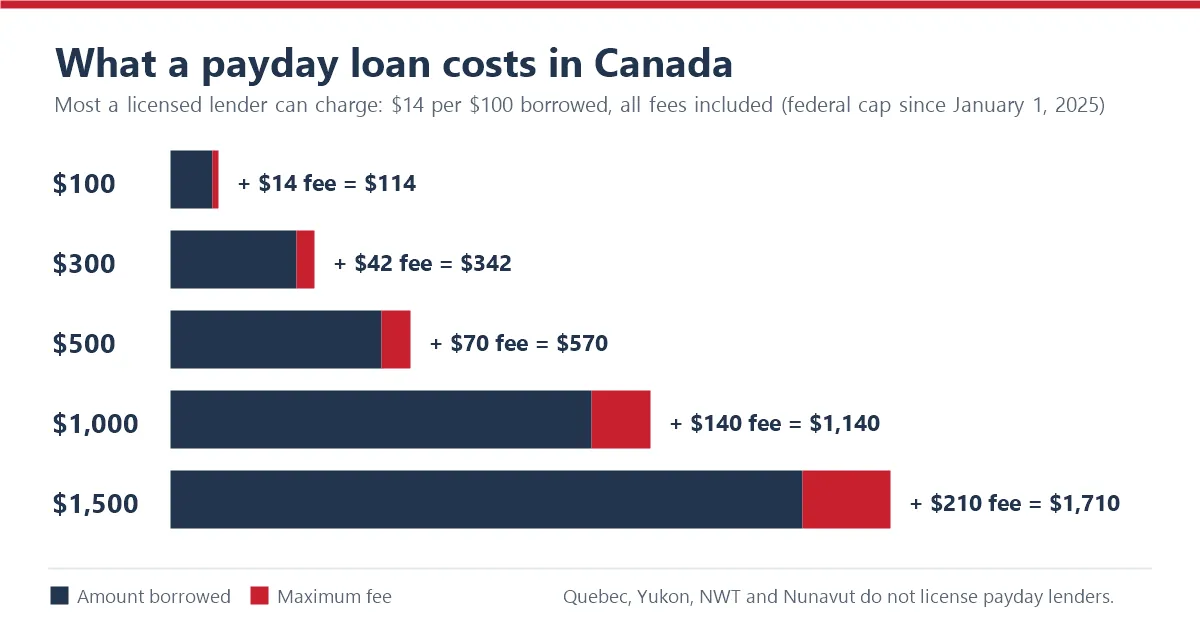
- Cost: at most $14 per $100 borrowed in the nine provinces that license payday lenders, so $500 costs $70.
- Free cancel: every province gives you one to two business days to change your mind. Cancel in time, hand back the money and you owe no fee.
- Who qualifies: Canadians with full time or part time job income paid into a Canadian bank account. All credit considered.
- Where: the nine provinces. Quebec and the three territories do not license payday lenders.
Every lender we match you with holds a licence in your province, and the cost is capped at $14 per $100 everywhere payday lending is legal. See your cost in dollars and your province’s cancellation right before you sign.
- Licensed Canadian lenders
- Capped at $14 per $100
- All credit considered
- No impact to check your options

A payday loan in Canada is a short-term loan of $100 to $1,500, repaid on your next payday, from a lender licensed by your province. Since January 1, 2025 it can cost no more than $14 per $100 borrowed, so a $300 loan costs $42. Nine provinces license payday lenders; Quebec and the three territories do not.
We are not a lender. Get Payday Loans Canada is a free matching service. Lenders and referral partners pay us a referral fee when we send them an application or when a referred application is funded; you never pay us. How we work.
What does a payday loan cost in Canada?
A payday loan costs at most $14 for every $100 you borrow, all fees included, in every province that licenses payday lenders. That ceiling comes from the federal Criminal Interest Rate Regulations that took effect on January 1, 2025. Before that date the provincial caps ran from $14 to $17. A lender charging more than $14 loses the legal exemption that lets payday loans exist at all.
| Amount borrowed | Maximum cost at $14 per $100 | Total to repay |
|---|---|---|
| $100 | $14 | $114 |
| $300 | $42 | $342 |
| $500 | $70 | $570 |
| $1,000 | $140 | $1,140 |
| $1,500 | $210 | $1,710 |
The fee is the same dollar amount whether the loan runs 14 days or the legal maximum of 62. On a typical two-week loan, $14 per $100 works out to an APR of about 365%. That is why a payday loan fits a one-time gap before payday and not a shortfall that comes back every month. Each amount has its own worked page: the $100 payday loan, the $300 payday loan and the $500 payday loan, and our guide to payday loan costs in Canada shows how the fee compares with other credit.
What are the payday loan rules in your province?
Every province caps the price at $14 per $100, but the other protections differ: how much of your pay a loan can take, how long you have to cancel, and what happens on a second or third loan. These are the rules that apply to any lender licensed in your province, online or at a counter.
| Province | Licensed by | Largest loan | Time to cancel free | Repeat-loan rule |
|---|---|---|---|---|
| Alberta | Service Alberta | $1,500, repaid over 42 to 62 days | Two business days | No second loan while one is open |
| British Columbia | Consumer Protection BC | 50% of net pay | Two business days | Third loan in 62 days: repay over three pay periods |
| Manitoba | Consumer Protection Office | 30% of net pay | 48 hours, not counting Sundays and holidays | No second loan while one is open |
| New Brunswick | Financial and Consumer Services Commission | 30% of net pay | 48 hours | No new loan from a lender you already owe |
| Newfoundland and Labrador | Digital Government and Service NL | 50% of net pay | 48 hours | Third loan in 62 days: instalment plan |
| Nova Scotia | Service Nova Scotia (permit) | $1,500, 62 days or less | 48 hours online; next business day in a store | No new loan from a lender you already owe |
| Ontario | Registrar, Payday Loans Act, 2008 | 50% of net income | Two business days | Third loan in 63 days: extended payment plan |
| Prince Edward Island | Registrar, Payday Loans Act | $1,500, 62 days or less | End of the second business day | Seven days must pass after repaying before a new loan |
| Saskatchewan | Financial and Consumer Affairs Authority | 50% of take-home pay | End of the next business day | One loan at a time |
Most provinces ban rollovers outright, where a lender charges a new fee to push the due date back, and Manitoba caps what one can cost. In Ontario, the rules are set out on the province’s payday loan rights page; British Columbia publishes its own through Consumer Protection BC.
The same rules follow you into every city. A borrower in Ottawa, London or Toronto gets Ontario’s two-business-day cancellation and the 63-day extended plan. Borrowers in Calgary and Edmonton get Alberta’s instalment structure. In Coquitlam, Abbotsford and the rest of the Lower Mainland, BC’s 50% of net pay limit applies. Halifax borrowers get Nova Scotia’s 48-hour online cancellation window, and Winnipeg borrowers get Manitoba’s 30% limit.
Why is an Alberta payday loan different?
An Alberta payday loan must run at least 42 days and no more than 62, and it must be repaid in at least two instalments that fall on your paydays. Alberta is the only province that banned the two-week, one-payment payday loan, and the $14 per $100 cap covers the whole term.
Here is a $500 Alberta loan over 42 days, repaid on three bi-weekly paydays:
| Payday | Instalment | Still owing after it |
|---|---|---|
| Day 14 | $190 | $380 |
| Day 28 | $190 | $190 |
| Day 42 | $190 | $0 |
| Total | $570 | Cost of borrowing: $70 |
The same $70 buys three times the time it buys in Ontario, so the APR on a 42-day Alberta loan is about 122% instead of about 365%. Instalments may not differ from each other by more than $10, and a bounced payment can cost you at most $25. The province explains the rules on alberta.ca.
Where are payday loans not allowed in Canada?
Payday loans are not legal in Quebec, Yukon, the Northwest Territories or Nunavut, because none of the four has been designated under section 347.1 of the Criminal Code. Without that designation, any loan above the 35% criminal rate of interest is illegal, and a $14 per $100 two-week loan is far above it.

If you live in one of the four, you can still apply here for a loan priced at or under 35% APR; lenders in our network lend in every province and territory. Our guide to where payday loans are legal in Canada explains what you can borrow instead and how to spot a lender breaking the law.
How do payday loans Canada lenders approve you?
Payday loans Canada lenders approve you mainly on your income, which they confirm through a read-only look at your bank deposits. The whole process runs online in four steps:
The check runs at any hour, but a request sent on a weekend waits for the next funding window; the payday loans on weekends page sets out that timing by day.
- Apply in about five minutes. Tell us your province, the amount you need from $100 to $1,500, and your pay schedule.
- Get matched with a licensed lender. We send your request to a lender licensed in your province.
- Verify income with IBV. The lender sends a secure IBV bank verification link. It takes about 60 seconds, reads your deposits only, and does not affect your credit score.
- Read the cost, sign and get funded. The agreement shows the fee in dollars, the due date and your cancellation right. Funds usually arrive by Interac e-Transfer, often within hours during business windows.

Prefer a specific route? See e-transfer payday loans for how the funds arrive, or bad credit payday loans if your score is the worry.
Who qualifies for a payday loan?
You qualify for most payday loans in Canada if you are of age, have steady employment income and have a Canadian bank account that receives your pay. Lenders look at:
- Age of majority: 18 or 19, depending on your province.
- Employment income: full-time or part-time pay, deposited regularly. A steady paycheque matters more than a perfect credit score.
- A Canadian bank account: the one your pay goes into, so IBV can confirm it.
- Contact details: a phone number, an email address and a home address.

In British Columbia, Newfoundland and Labrador, Ontario and Saskatchewan, the loan cannot be more than half your net pay; in Manitoba and New Brunswick it is 30%. On $1,200 of take-home pay per cheque, that means $600 at most in Ontario and $360 at most in Manitoba.
Do payday loans affect your credit score?
Usually not when you repay on time. Most payday lenders do not report loans to Equifax or TransUnion, so a loan repaid on the due date never appears on your credit file. That cuts both ways: a repaid payday loan does not lower a good score, and it does not build a thin one either.
A default is different. An unpaid balance is usually sold to a collection agency, and collection agencies do report. The account is coded R9, the lowest rating on the Canadian scale, and it stays on the file for up to six years from the date of last activity. The damage comes from the repeat cycle and the default, not from a single loan repaid on payday. If a loan is already past due, the next section and our guide to getting out of payday loan debt cover the way back.
What happens if you cannot repay on payday?
If a payday loan payment bounces, the lender can charge one capped default fee and your bank can charge its own NSF fee, and most provinces ban rolling the loan over for a new fee. The default fee is capped at $25 in Alberta and $20 in New Brunswick and Nova Scotia.
- Call the lender before the due date. Ask for a payment arrangement before the debit bounces.
- Know your extended plan. On a third loan within 63 days in Ontario, or 62 days in British Columbia and Newfoundland and Labrador, the lender must let you repay in instalments.
- Do not borrow again to repay. If one loan is paying off the last, read our guide to getting out of payday loan debt.
How do you pick a lender when the price is capped?
Because every licensed lender charges at most $14 per $100, you pick a payday lender on its licence, its disclosure and how it treats you if something goes wrong, not on price. Check four things:
- The licence: the lender must be licensed in your province. Ask for the licence number and check it with the regulator in the table above.
- The written cost: the agreement must show the fee in dollars and the APR before you sign.
- The cancellation right: the agreement must tell you how long you have to cancel for free.
- No upfront payment: a real lender never asks for money, a gift card or an e-Transfer before you are funded. That is a scam.
What should you check before taking a payday loan?
Check whether a cheaper option covers the same gap before you take a payday loan, because each of these costs less than $14 per $100:
- A pay advance from your employer, often free.
- A small loan from your credit union, usually priced well under the 35% APR limit.
- Your bank overdraft, if you can clear it within weeks.
- A payment arrangement with the company you owe, such as a utility or landlord.
If none of these works and the gap is real and one-time, a licensed payday loan at the capped price, repaid on schedule, is the next step. The Financial Consumer Agency of Canada publishes the same checklist. More guides are in our payday loan guides.
Payday loans Canada FAQs
How much can I borrow with a payday loan in Canada?
Up to $1,500, the legal maximum for a payday loan. In British Columbia, Newfoundland and Labrador, Ontario and Saskatchewan the loan also cannot exceed half your net pay, and in Manitoba and New Brunswick 30%.
How much does a $500 payday loan cost?
At most $70, so you repay $570. The $14 per $100 cap includes every fee the lender charges for the loan.
Can I cancel a payday loan after signing?
Yes. Every province with payday lending gives you a free cancellation window, from the end of the next business day in Saskatchewan to two business days in Alberta, British Columbia and Ontario. You return the money and the lender refunds its charges.
Can I get a payday loan with bad credit?
Yes. Lenders in our network decide mainly on your employment income, confirmed through IBV, so a low credit score does not rule you out.
Can I have two payday loans at once?
Usually not. Alberta, British Columbia, Manitoba, Newfoundland and Labrador and Saskatchewan allow one open payday loan at a time, and New Brunswick and Nova Scotia bar a new loan from a lender you already owe.
Are payday loans legal in Quebec?
No. Quebec has not designated payday lending, so any loan above 35% APR is illegal there. Quebec residents can still apply here for a loan priced at or under 35% APR.
Does checking my options affect my credit score?
No. Matching through Get Payday Loans Canada and the IBV bank verification do not affect your credit score. A lender may review your credit file before it makes a final offer.
Is Get Payday Loans Canada a lender?
No. We are a free matching service. Licensed lenders fund and service the loan, and lenders or referral partners pay us a referral fee.
Ready to see your options?
Apply in about five minutes, see the cost in dollars from a lender licensed in your province, and keep your cancellation right in mind before you sign.
About Our Editorial Team
Get Payday Loans Canada is a loan matching service, not a lender or broker, and does not make credit decisions or fund loans. Payday loans are short-term, high-cost credit regulated by the provinces that license them. The maximum cost of borrowing is $14 per $100 borrowed; example: a $300 payday loan for 14 days costs $42, an annual percentage rate of about 365%. Payday loans are not available in Quebec, Yukon, the Northwest Territories or Nunavut. Borrow only what you can repay on your next payday, and check lower-cost options such as an employer pay advance or a credit union loan first. Approval depends on the lender’s criteria.